<div style='background-color: none transparent;'><a href='http://www.rsspump.com/?web_widget/rss_ticker/news_widget' title='News Widget'>News Widget</a></div>

Financial intermediation and Economic Growth

Jan 7, 2012 0 comments
Quickly development of banking sector, has separate implication in monetary sector. This thing is because of development of fast financial sector will cause various monetary magnitudes to become changing, having implication to more and more (the complex monetary policy transmission). In line with increasingly grows it banking system, monetary policy effectiveness increasingly depends on to condition of financial sector. This thing happened because creation process of money no longer fully determined by central banking policy but also influenced by behavior of banks in doing credit contraction. In this bearing, money supply no longer have the character of exogenous but rather haves the character of endogenous, causing monetary policy concept must be extended by entering factors which can influence behavior of bank and debtor in doing credit insurance expansion and money supply. Thereby, policy in banking area no longer solely holds important role in expansion of monetary infrastructure for the agenda of overcoming gap between savings and investment but also plays important role in looking after stability of macroeconomics through its (the interrelationship with monetary policy effectiveness).

The economists initially has difference of opinion sight about the role of monetary intermediary in economic development. Firstly opinion about the role of important intermediaries, while assessing second opinion on the contrary. Bagehot and Hicks in Zulverdi et.al (2005), for example, believes that banking system plays important role in mobilization of fund to finance industrialization era in English. And so do with Schumpeter (1911) what looks into that banking system push technological development passed its(the role in identifying and finances the entrepreneur having ideas innovative. On the contrary, Robinson (1952) sees that banking system is not economic activity impeller but exactly development of banking system which depend on development of corporate world. Lucas (1988) also criticizes opinion which too looks into important the role of monetary factors in chartered investment counsel growth.

In development hereinafter, firstly opinion tends to increasingly popular. Various studies compare pass by quickly state and analysis at industrial level and company concludes that banking system plays vital role in pushing chartered investment counsel growth. Literature indicates that development of banking system influences level of savings, investment, innovation of technology, and growth of long-range chartered investment counsel in a state. Various empiric studies even proves that development of banking system can predict development of chartered investment counsel forwards. In financial sector, for the agenda of overcoming gap between savings and investment, effort moves domestic source of fund is done by developing financial sector infrastructure, especially banking industry.

As impact of the limited motion space of financial sector hence happened is so-called by McKinnon and Shaw as "financial repression" what causes "shallow finance", that is channel doesn't of fund (buying power) efficiently to activities of efficient and productive chartered investment counsel also, so that economic growth become blocked.

Levine (1997) divides the functions of the financial system into five basic functions, namely:
  1. Savings mobilization function, The financial system is functioning properly is its ability to raise funds with transaction fees and costs to a minimum of information. Here the credibility to play an important role as a credible financial system will be able to collect public funds with low costs.
  2. Information collection and allocation functions funding sources, Financial system that functions well is the ability to collect, process and translate information into investment decision-making tool that looks at price movements of financial instruments that reflect the fundamental condition.
  3. The function of monitoring and supervision of company, The financial system is functioning properly the low cases of fraud by management because the monitoring of company management.
  4. Risk management function, Financial system that functions well is the ability to better diversify risk.
  5. Function facilitate transactions, A good financial system is the existence of mechanisms of financial transactions fast, secure, and low cost.


Economic Growth And Productivity Increase
Poor countries densely populated and many live on the extent and limits of living raise difficulties. high living standards and growing. While some developed countries like United States and Canada, West European countries, Australian, New Zealand, and Japan enjoys life level is height that is increasing from time to time. Population means added labor and legal validity Fewer Added results lead to the smaller increase in output, decline in average product and the decrease in living standards. Causative the low of earnings in nations is growing is increase of a real resident quickly which is not made balance to with strength pushing economic growth in the form of increase of amount and quality of source of nature, capital, and technology progress (Levine and Loayza, 2002).

Meanwhile increase of goods amounts capital, technology progress, and increase of quality and skill of labor in advance nations delivers big output of which can increase life level. With existence of level of available and high productivity goods of capital will push chartered investment counsel growth (Diamond and Dybvig, 1983).

Affecting The Economic Growth Factors
The factors that affect economic growth include natural resources, human resources, capital resources, and expertise or entrepreneurship (Digg, 1983).
  1. Natural Resources, Natural resources includes land and natural resources such as soil fertility, climate/weather, forest products, mining, and seafood, greatly affect a nation's industrial growth, especially in terms of supply of raw materials production. Meanwhile, the expertise and entrepreneurship needed to process raw materials from nature, becomes something that has a higher value (also known as the production process).
  2. Human Resources, Human resources also determine the success of national development through the number and quality of the population. Large population is a potential market to market production results, while the quality of the population determines how large the existing productivity.
  3. Capital Resources, Human capital needed to process these raw materials. Capital formation and investment is intended to excavate and process the wealth. Capital resources in the form of capital goods is very important for the smooth progress and economic development because of capital goods may also increase productivity.
  4. Expertise or Entrepreneurship, According Schumpeter, mover of progress is an entrepreneur with ideas for new products, new ways while yielding products or some other innovation.


Theories And Models of Economic Growth
In the era of classical economists like Adam Smith in his essay book entitled An Inquiry into the Nature and Causes of the Wealth Nations, to analyze because the entry into force Economic growth factors that determine economic growth. After Adam Smith, several other classical economists like Ricardo, Malthus, Stuart Mill, also discussed issues of economic development.
  1. Schumpeter's Theory of Innovation (1911) , In this theory emphasizes the innovation factor entrepreneurs as economic growth engines capitalistic. The dynamics of competition will encourage this.
  2. Harrot-Domar Growth Model (1969), This theory emphasizes the concept of natural growth rate. Besides the quantity of labor input is also taken into account because it increases the efficiency of education and this exercise. Model can determine how much savings or investments needed to maintain natural economic growth rate is the number of natural economic growth rate multiplied by the capital-output ratio (Diamond, 1984).
  3. Leontief Input-Output Model, This model is a picture of the flow and the relationship of each industry. By using this table, the planning of economic growth can be done consistently because it can be known picture of the flow of input-output relationship of each industry. Relationship is measured by input-output coefficients and in the short term or unchanging considered constant (Bernanke and Gertler, 1986).
  4. Lewis Growth Model , This model is a model that explains the special case of a developing country of many (dense) populations. The emphasis is on the transfer of excess population to the modern sector of agriculture sector in the industrial capitalists who financed from the surplus profits (Bernanke and Gertler, 1986).
  5. Rostow's Economic Growth Model, This model emphasizes stage of review on-stage history of economic growth and the characteristics and requirements of each. These stages are stages of a traditional society, a prerequisite stage of take-off, take-off phase, stage of movement toward adulthood, and finally high consumption stage (Fuerst, 1994).

Generalized Method of Moment (GMM): Arelano-Bond Estimator

Jan 6, 2012 0 comments

Pada bagian sebelumnya sekilas telah dibahas mengenai permasalahan ekonometris dalam data panel dinamis maupun permasalahan data panel dengan menggunakan variabel tenggat terikat (lag dependen). Pada bagian ini akan menelaah lebih mendalam mengenai data panel dinamis ( dynamic panel data) dengan menggunakan Generalized Method of Moment (GMM).

GMM-diff dikembangkan oleh Holtz-Eakin dkk (1988) dan Arellano dan Bond (1991). Prosedur yang digunakan memberikan beberapa keuntungan terhadap perkembangan model panel yang melibatkan variabel tenggat terikat. Pertama, potensi yang dapat menyebabkan bias pada estimator dihilangkan dengan jalan meniadakan μi. Kedua, penggunaan variabel instrumen dapat menghasilkan estimator yang konsisten walaupun terdapat variabel endogen dalam model yang diestimasi. Ketiga, penggunaan variabel instrumen memungkinkan keberadaan estimator yang konsisten walaupun terdapat variabel measurement error (Oliveira, et.al.,, 2005).

Estimator GMM-diff menggunakan persamaan first difference. Transformasi ini akan menghilangkan μi serta memungkinkan variabel-variabel tenggat endogen pada periode kedua dan sebelumnya untuk menjadi variabel instrumen yang tepat asalkan tidak terdapat korelasi serial pada random error. Hal itu dapat diuji dengan menggunakan uji untuk korelasi serial untuk residual dalam bentuk first difference. Selanjutnya pada tahun 1998, kelemahan dari estimator GMM-diff mulai dibicarakan lebih lanjut.

Blundell dan Bond (1998) menunjukkan bahwa dalam model autoregressive distributed lag dapat terjadi bias pada estimator first difference sebagai akibat lemahnya variabel instrumen karena tidak terdapat hubungan yang erat antara variabel dan variabel instrumennya. Cara yang sederhana untuk mendeteksi keberadaan lemahnya variabel instrumen adalah melakukan perbandingan antara hasil yang dicapai oleh koefisien autoregressive melalui estimator GMM-diff dengan alternatif estimator (OLS dan within group). Dalam model AR (1), ditunjukkan bahwa OLS estimator dengan keberadaan μi akan menghasilkan parameter yang upward bias (Hsiao, 1986) dan within group memberikan parameter yang downward bias terutama pada panel dengan periode analisis yang pendek (Nickell, 1981). Hal ini berarti bahwa estimator yang konsisten akan memiliki parameter yang nilainya di antara nilai parameter yang diestimasi dengan menggunakan OLS dan within group. Jika variabel instrumen yang digunakan lemah, maka parameter yang dihasilkan oleh GMM-diff akan tetap mengalami downward bias.

Untuk mengoreksi kelemahan estimator GMM-diff maka Blundell dan Bond (1998) mengusulkan agar persamaan dalam first difference harus dikombinasikan dengan persamaan dalam bentuk level agar instrumen yang digunakan harus tetap ortogonal terhadap μi. Variabel terikat dalam bentuk level seharusnya berkorelasi dengan μi sehingga memerlukan situasi yang mengijinkan adanya korelasi antara variabel penjelas dan μi. Hal ini tidak memungkinkan penggunaan variabel instrumen dalam bentuk level terhadap persamaan dalam bentuk level. Selanjutnya, Blundell dan Bond (1998) juga menekankan bahwa dalam model autoregressive distributed lag, seri dari first difference dapat tidak berkorelasi dengan μi asalkan saja seri tersebut memiliki rata-rata yang stasioner. Hal ini menjadikan lagged first difference dapat digunakan sebagai instrumen pada persamaan dalam bentuk level. Ketepatan instrumen yang digunakan dapat diuji dengan Sargan test of overidentifying restrictions.

Dari uraian sebelumnya dapat dilihat bahwa estimator GMM-diff maupun SYS GMM dibangun dalam kerangka GMM. GMM adalah metode estimasi yang terbaik untuk panel data yang melibatkan variabel tenggat terikat sebagaimana yang disebutkan pula oleh Verbeek (2000: 329-331), Baltagi (2001: 130-131) dan Green (2000: 583). Titik awal dari estimasi GMM adalah suatu hubungan teoritis yang harus dipenuhi oleh parameter. Gagasannya adalah memilih parameter yang diestimasi sedemikian rupa sehingga sedekat mungkin dengan hubungan teoritis tersebut. Hubungan teoritis ini diisi oleh sampel dan estimasi dipilih untuk meminimalkan jarak terbobot di antara nilai teoritis dan nilai aktual. GMM tidak memerlukan informasi tentang bentuk distribusi yang tepat dari residual.

Hubungan teoritis yang biasanya harus dipenuhi oleh parameter biasanya adalah orthogonality condition di antara beberapa fungsi parameter f(θ) dan sekelompok variabel instrumen variabel Zt:
E (f (θ)' Z) = 0 ............. (1.1)


di mana θ merupakan parameter yang diestimasi. Estimator GMM memilih parameter yang diestimasi sedemikian rupa sehingga hubungan-hubungan sampel di antara instrumen-instnunen dan fungsi ƒ sedekat mungkin dengan nol sebagaimana didefinisikan oleh kriteria fungsi:
J(θ) = (m(θ) = (m(θ))' Am(θ)) ............. (1.2)


di mana m(θ) = f(θ)'Z dan A adalah matriks terbobot. Beberapa symmetric definite matrix A akan menghasilkan q sebagai suatu estimasi yang konstan. Tetapi, dapat diperlihatkam bahwa suatu kondisi perlu (bukan kondisi cukup) untuk mencapai estimasi efisien dari q adalah membuat A sama dengan invers dari matriks kovarians momen sampel m.

Beberapa estimator lain dapat dilihat sebagai kasus khusus dari GMM. Misalnya, OLS dapat dilihat sebagai estimator GMM di mana variabel penjelas tidak berhubungan dengan residual.

GCG and Type of Ownership in Banking Industry

Jan 5, 2012 0 comments
According to Caprio and Levine (2002), corporate governance in the banking industry meets two essentials problems: (i) agency problems in banking industry is in very high levels (ii) regulation and supervision that are applied to the banking industry, in a separate level, even can off-set the mechanism of the corporate governance itself. Hart (1995) stated that the corporate Governance arises when the agency problems in internal corporation increase and the transaction cost can not be solved by a contract explicitely. The statement is supported by Fama and Jensen (1983):
“…agency problems arise because contracts are not costlessly written and enforced”
Agency problem in the banking industry has the different dimension with the other industries since there is a regulator’s role which represents stakeholders’ needs. Related with the state-owned bank, agency problems are getting complex since the possibility of the rising of multi agents and principal (Tandelilin, 2004). So that, in the banking industry there is a dimension of principal- agent problems that are different with another industry (Llewellyn and Sinha, 2000).

Agency problems in the banking sector are in two categories. The first is the agency problem caused by debt (agency cost of debt) and the second is the agency problem that related to the separation of ownership and control. Ciancanelli and Gonzalez (2000) stated that the approach the agency theory which are trusted to be existed in order to understand the corporate governance problems in the banking industry has to be reevaluated because of the difference of the basic premise of the agency theory used and the characteristics of the banking industry in spite of the problem of the asymmetrical information that is related to all of the sides.

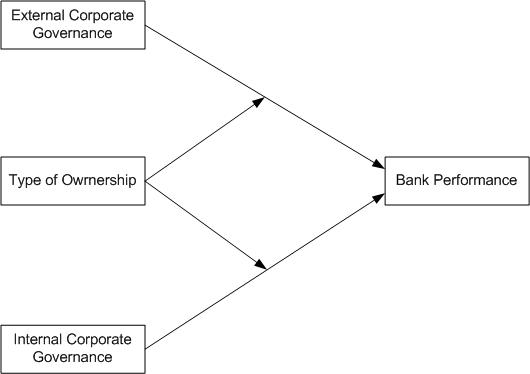
The corporate governance in banking industry is related to two things. First, the external corporate governance with its financial safety nets and prudential regulation. Second, internal corporate governance with its accountability, disclosure, and transparency that departs from creating the arising of the bank system and minimizes the moral attitudes deviation. By using the frame of the corporate governance in banking industry by Ciancanelli (2000), Nam (2004), and Mehran (2003), this research develops three construction : (1) External corporate Governance (ECG) (2) Internal Corporate Governance (ICG) and (3) Type of Ownership.

THEORITICAL FRAMEWORK
Corporate Governance includes (1) set of rules that sets the relationship of the shareeholders, manager, creditor and others deal with the rights and responsibility of each side, and (2) set of mechanism which guarantees direct and indirectly of the application of the set of rules (ADB, 2001). Deal with the banking industry, OECD (1999) described corporate Governance as follows:
……’a set of relationship between the company’s management, its board, its shareholders and other stakeholders. Corporate Governance also provides the structure through which the objectives of the company are set, and the means of attaining those objectives and monitoring are determined. Good corporate governance should provide proper incentives for the board and management to pursue objectives that are interests of the company and shareholders and should facilitate affective monitoring, thereby encouraging firms to se the resource more efficiently’
Macey and O’Hara (2001) stated that corporate governance in banking industry has a wide thought since there is a type of specific contractual that happened in the banking industry, some of them are the protection to the shareholders and stakeholders. Besides that, the specific characteristic of bank needs government’s intervention in the type of regulations and supervisions to control the bank management’s act.

External Corporate Governance
It is clear that developing models of corporate governance in banking requires that we understand how regulation affects the principal’s delegation of decision making authority (Jensen and Smith, 1984) and what effects this has on the behaviour of their delegated agents. (Freixas and Rochet, 1997). Regulation has at least four effects. Firstly, the existence of regulation implies the existence of an external force, independent of the market, which affects both the owner and the manager.

Secondly, because the market, in which banking firms act is regulated, one can argue that the regulations aimed at the market implicitly create an external governance force on the firm. Thirdly, the existence of both the regulator and regulations implies the market forces will discipline both managers and owners in a different way than that in unregulated firms. Fourth, in order to prevent systemic risk, such as lender of last resort, the current banking regulation means that a second and external party is sharing the banks’ risk. (Ciancanelli, 2000).

As the external corporate governance mechanism, banking regulation reflect in safety nets facilities such as deposit insurance (explicit and implicit) and lender of the last resort of central bank. In order to keep financial safety nets from moral hazard, generally, the government applied the prudential regulation and supervision. In this case, Dewatripoint and Tirole (1993) stated that the prudential regulation and supervision mostly meant to keep the bank solvency and as the incentive for stakeholders to control or apply the corporate governance in banking sector widely.

Internal Corporate Governance
The Bassel Committee on banking supervision (1999) stressed that the board and senior management are in fully responsible in apllying good corporate governance. In order to support the effectiveness of editorial board’s work, some aspects are needed to consider about, they are: board’s structure and independency, function and activity, compensation and other obligations (Nam, 2004). The internal corporate government in this research is divided into two; they are internal corporate governance- manager (ICG- manager) and internal corporate governance owner (ICG- owner). The difference of ICG- manager and ICG- owner is in the focus control. ICG- manager stressed to the internal of the manager which is stimulated externally through the attention of the owner to the manager’s interest which is actualized in the remuneration and the other types of another human resource development to increase the bank revenue (Jensen and Murphy, 1990). The ICG- owner stressed in the control throughout the manager to increase the efficiency.

Ownership Dispersion
Ownership dispersion depends on the numbers of shareholders. Practically, the extreme focused types of ownership are often faced in the close private bank. However, the dispersed type of ownership is state-owned bank, because the government act as an agent. Between the both of those extreme points, there is a possibility to the private bank to sell some of their stakes to the public. So that creates the form of majority and minority ownership. Husnan (2001) explained the agency problems to the ownership dispersion in the frame of corporate governance by grouping the company based on the three characteristics of the ownership. The three of the characteristics are (a) dispersed ownership (b) closely held ownership and (c) the state owned firms.

Theoretical background
Conceptually, this research classified the type of the bank ownership into four groups. They are:
  • Foreign or joint venture bank
  • Private unlisted bank
  • Private listed bank
  • Government (state-owned) bank
Each of these ownership types has different level of agency problem. In this case the foreign bank is the banks that have reputation and internationally trusted which are sure for the market to apply good corporate governance. Generally, the closed private banks are controlled tightly by ownerships in the relatively small number.

This structure of ownership is an extreme closely held ownership, because the relatively small amount of the owner are able to fully control management mechanism for maximizing the company’s financial performance. As the result, the degree of the agency problems between the owners with the manager tend to be low.

The public private bank moved the degree of the agency problems in Indonesia to conflict of the major owner’s interest and the minor one. Agency problem might be different if there was no major owner who controlled the management. The wide dispersed ownership by the public will move the agency problems to the conflict of interest between the dispersed owners with the manager. The condition in Indonesia indicated more in the major owner who controlled the management’s performance, so it’s potential in raising the conflict of the majority and the minority. The state-owned bank is a unique ownership because practically, there is no pure owner who can control to the company management. The government, both in context of the executive and legislative and all sides related with the management of the state-owned bank as an agent without principal. However, the state-owned bank is a chosen ownership that extremely against the closely held ownership, because the forms of the ownership are dispersed completely. So, the degree of the agency problem in this are is counted as the strongest relatively compared with the other forms of ownership.

Based on the typology of the ownership’s form and potential agency problems, it is possible to describe the agency problems in banking industry as in table 2-1. In the table, the agency problems might happen between the owner vs. manager and between the manager/ the owner vs. creditor or the minority.
Table 2-1. The agency problems and type of ownership in banking industry
Type of Conflict Reputable Foreign Bank Private Bank Public listed Bank State-owned Bank
(Proxy for GCG) Closely held Minority-majority Dispersed
Manager vs. owner
*
**
***
>
****
Manager/owner vs. Creditor/ Minority
*
**
***
****
Note: *= low** = high *** = higher **** = highest

RESEARCH MODEL
The agency problems caused firm performance cannot run optimally. The way to detect the agency problems is learning the management efforts which are related to external corporate governance as well as internal corporate governance. The different type of ownership have the different level of utility and the different ability in controlling the management. Figure 2-1 shows the research’s framework that bank performance is effected by three exogenous constructions.
Figure 1.
Research Framework


Operating Variables
External Corporate Governance. This research used the aspect of regulation and finance supervision as the reflection of external corporate governance by stressing the in the obedience factor to regulation and supervision. The composite variable of regulation obedience is in the form of logistic probability that is used as proxy of external corporate governance. The higher the probability of the regulation’s obedience and so higher the bank willingness to operate the company under the regulations. The external corporate governance variables that related to the regulation’s obedience consist of capital aspect and earning assets. This research used the government classification about the healthy and unhealthy bank during 1999 until 2001 to build analysis model. There are the evidence for the score: 1 for healthy bank and 0 for unhealthy bank. The unhealthy banks or under controlled banks reflect the consequence of the failed bank management attitudes or disobey the regulations. The healthy banks reflect the discipline of the bank management in obeying the regulations.

Internal Corporate Governance-manager are taken from pay-performance sensitivity. Jensen and Murphy (1990) had a research about pay-performance sensitivity. Pay-performance sensitivity is reflected from the parameter coefficient which is estimated with the pay regression model and the incentive to the wealth of the stakeholders. In this case ICGM is the internal corporate governance as the manager’s interest representation that are taken from the estimation of parameter coefficient.

Internal Corporate Governance-owner. ICG-owner is owner’s direct interference in the form of manager controls. Some of them are in actions on behalf of and for owner and the command for internal editor. The essence of the ICG- owner is in the efficiency factor of preventing manager from doing his own interest. Net interest margin (NIM) represents ICG- owner. This research has an assumption that the use of NIM in a period hasn’t reflected the appropriate mechanism for the owner in applying ICG owner. In other words, this research stresses to the stability of NIM from one to another period that reflected more in the success of the owner control mechanism than in the applying of NIM in a period. So that we use coefficient of variation NIM reflected internal corporate governance-owner interest.
Generally, empirical research of the effect of corporate governance and type of ownership to the bank performance can be explained by agency theory. However, there is a dimension of principal agency problems that are more complex in banking industry that cannot be found in non-financial banking industry. Besides, the existence of regulation factor as the reflection of public interest caused the control market mechanism as one of the mechanism of corporate governance to discipline the manager to become more useless. Moreover, with deposit insurance program, investors tend to be passived in controlling to prevent every risk increasing that are done by the owner or the stakeholder.

The agency theory, formalized by Jensen and Meckling (1976), posits that the agency costs of deviation from value maximization increase as managers’ stakes decrease and ownership becomes more disperse. Agency problem in banking industry in the context of corporate governance through the approach of ownership dispersion results as follow:
  • the interference of regulation in the concentrated ownership (private unlisted Bank) and dispersed ownership (state-owned bank) caused agency problems in high level degrees. This result is in line with the view that is based on the ownership’s aspect stated that the state-owned companies naturally are less efficient than the private companies. Governance view stated that private companies are more successful in handling the corporate governance problems than the state-owned companies. Reversely, private ownership are based on their skills that are better in contracting and incentives (Schleifer and Vishny (1994)
  • ;
  • Regulation intervention in less concentrated ownership (private listed bank) caused the agency problems fall in lower level degree. According to the agency theory, the separation of ownership and controlling functions between the principal and agents is possible to happen in the private listed bank than in the private unlisted bank. However, in banking industry, the agency problems that raised between the major and minor shareholders or between the manager- stakeholders “are ignored” by the function of regulator (Llewllyn and Sinha, 2000).

Market Risk Research

Jan 2, 2012 0 comments
Terdapat dua aliran penelitian tentang eksposur risiko pasar. Studi dalam aliran pertama menetapkan bahwa harga saham adalah sensitif terhadap perubahan suku bunga, nilai tukar, dan harga komoditas. Mereka juga menilai tingkat hubungan cross-sectional antara sensitivitas harga saham dengan perubahan nilai pasar/harga dan keterbatasan jumlah informasi risiko pasar yang tersedia pada penelitian sebelum FRR No. 48. Aliran kedua secara khusus membahas manfaat informasi yang dimandatkan oleh FRR No. 48.

Lima penelitian dalam aliran pertama berhubungan dengan studi ini. Schrand (1997), dengan menggunakan data regulator swasta, menunjukkan bahwa lembaga tabungan dan pinjaman menggunakan tingkat suku bunga derivatif dalam mengurangi sensitivitas harga ekuitas mereka terhadap perubahan tingkat suku bunga. Tufano (1998), menggunakan analyst-generated informasi prifat, menunjukkan bahwa harga komoditas hedging merendahkan sensitivitas harga saham tambang emas terhadap perubahan harga emas. Jorion (1990), dengan menggunakan pengungkapan publik, menemukan bahwa sensitivitas harga saham perusahaan terhadap harga dolar AS dari perdagangan tertimbang mata uang asing lebih besar pada perusahaan-perusahaan dengan operasi asing yang lebih tinggi. Bartov dan Bodnar (1994) mencatat bahwa pasar tidak sepenuhnya memasukkan informasi tentang sensitivitas perusahaan terhadap fluktuasi nilai tukar mata uang asing sampai sensitivitas tersebut mempengaruhi laporan laba akuntansi. Hasilnya menunjukkan bahwa pengungkapan publik tentang luasnya operasi asing hanya memberikan ukuran yang tidak lengkap dari sensitivitas risiko mata uang perusahaan. Terakhir, Wong (2000) mencatat bukti yang lemah dan tidak konsisten hubungan antara sensitivitas harga saham perusahaan terhadap perubahan nilai tukar dan posisi derivatif yang dilaporkan sesuai dengan persyaratan SFAS No 119 (FASB 1994d).

Studi dalam aliran penelitian pertama menunjukkan bahwa return sekuritas sensitif terhadap perubahan nilai pasar/harga. Mereka juga menunjukkan bahwa, sebelum FRR No. 48, sensitivitas harga saham perusahaan pada perubahan nilai pasar/harga dikaitkan dengan keterbatasan jumlah informasi risiko pasar industri spesifik. Namun, konsisten dengan review SEC tentang pengungkapan publik, mereka menemukan bahwa informasi SFAS No 119 tidak begitu berguna bagi investor. Tak satu pun dari studi tersebut memfokuskan pada kegunaan informasi FRR No. 48. Namun, Schrand (1997), yang menggunakan data regulator yang sama dengan pengungkapan tabular FRR No. 48, menunjukkan bahwa Disclosure FRR No. 48 mungkin berguna bagi investor. Demikian pula, Wong (2000) menunjukkan bahwa pengungkapan yang lebih komprehensif yang disyaratkan oleh FRR No. 48 adalah lebih baik dalam menggambarkan eksposur risiko pasar perusahaan dan mengatasi beberapa permasalahan defisiensi yang diidentifikasikan dalam informasi SFAS No. 119.

Literatur aliran kedua yang terkait, mencakup empat studi yang secara eksplisit memeriksa kegunaan informasi FRR No. 48. Namun, tiga dari yang pertama tidak menggunakan informasi aktual FRR No. 48. Selanjutnya, mereka mengembangkan proxy untuk Disclosure FRR No. 48 atas dasar informasi bahwa pengungkapan perusahaan minyak dan gas serta bank sebelum FRR No. 48 menjadi efektif. Untuk sampel penghasil minyak dan gas, Rajgopal (1999) membangun proxy untuk pengungkapan tabular dan pengungkapan sensitivitas FRR No. 48 dari pengungkapan cadangan nilai wajar (SFAS No. 69, FASB 1982) dan jumlah derivatif yang tidak tetap (SFAS No 119, FASB 1994d). Dia melaporkan hubungan positif antara proksi Disclosure FRR No. 48 dan sensitivitas return saham perusahaan pada perubahan harga minyak dan gas. Rajgopal dan Venkatachalam (2000), untuk sampel dari 25 indutri kilang minyak, menilai hubungan cross-sectional antara sensitivitas laba dan sensitivitas return pada harga minyak. Mereka menemukan hubungan positif antara proksi Disclosure sensitivitas laba FRR No. 48 dan persepsi pasar tentang eksposur risiko. Ahmed et.al. (2000) menguji maturity gap disclosure bank komersial. Mereka menemukan bahwa pengungkapan tersebut berguna dalam memprediksi perubahan net interest income bank. Terakhir, Thornton dan Welker (2000) menguji pengaruh pengungkapan aktual FRR No. 48 tentang penilaian pasar terhadap sensitivitas harga saham perusahaan pada perubahan harga minyak dan gas. Mereka menemukan bahwa penghasil minyak dan gas mengungkapkan analisis sensitivitas atau perubahan sensitivitas harga saham VAR experience lebih besar dari perubahan sensitivitas harga minyak dan gas pasca FRR No. 48 kemudian mentabulasi perusahaan disclosers dan nondisclosers.

Singkatnya, aliran kedua penelitian ini menunjukkan bahwa pengungkapan risiko pasar FRR No. 48 memberikan informasi yang berguna bagi investor. Namun, bukti-bukti sampai saat ini didasarkan pada sebagian besar proksi untuk informasi FRR No. 48, dan terbatas untuk perusahaan minyak dan gas serta industri perbankan. Sebaliknya, penelitian ini menguji efek pasar pengungkapan aktual FRR No. 48, dengan menggunakan sampel perusahaan non finansial yang luas. Selain itu, penelitian saat ini terutama menguji hubungan antara sensitivitas harga saham terhadap perubahan nilai pasar/harga dan informasi eksposur risiko pasar. Sebaliknya, penelitian ini menguji sensitivitas volume perdagangan harian pada perubahan nilai pasar/harga. Pada bagian berikutnya, penelitian ini menjelaskan mengapa sensitivitas tersebut berhubungan positif dengan ketidakpastian dan keragaman pendapat investor tentang eksposur risiko pasar perusahaan, dan mengapa penelitian ini memprediksi bahwa sensitivitas volume perdagangan tersebut menurun setelah pengungkapan FRR No. 48.

Recent Research
Penelitian sebelumnya menyimpulkan bahwa volume perdagangan meningkat dengan ketidakpastian dan keragaman pendapat investor (Karpoff 1986; Kim dan Verrecchia 1994; Kandel dan Pearson 1995; Barron 1995; Bamber et.al, 1997, 1999.). Model Kim dan Verrecchia (1994) tentang likuiditas pasar dan volume perdagangan memberikan dasar konseptual untuk pengembangan hipotesis.

Kim and Verrecchia (1994)
Model Kim dan Verrecchia (1994) menangkap dua fitur yang menonjol dari pengaturan pengungkapan: ketidakpastian/uncertainty (didefinisikan sebagai ketidak-akuratan informasi publik) dan keanekaragaman pendapat/diversity of opinion (didefinisikan sebagai 1 minus korelasi antara dua informasi). Dalam model ini, pelaku pasar menerima sinyal yang berisi informasi tidak tepat tentang ketidakpastian arus kas perusahaan di masa depan, dan memutuskan apakah akan mengenakan biaya dalam pemrosesan lanjutan sinyal informasi nilai relevan. Meskipun Kim dan Verrechia (1994) (selanjutnya KV) menerapkan model mereka pada sinyal release laba yang berisi informasi tentang antisipasi arus kas perusahaan, penelitian ini menerapkan model dengan perubahan dalam sinyal nilai pasar/harga (seperti perubahan suku bunga, nilai tukar, atau harga komoditas). Pergerakan nilai pasar/harga bukan merupakan sinyal spesifik perusahaan, namun literatur sebelumnya menunjukkan bahwa hal ini memiliki implikasi spesifik perusahaan karena berhubungan dengan return ekuitas dan laba (Jorion 1990; Schrand 1997; Tufano 1998; Ahmed et.al, 2000). Penelitian ini menempatkan bahwa implikasi spesifik perusahaan dari pergerakan tersebut untuk mengantisipasi arus kas masa depan yang tidak jelas sebelum FRR No. 48, ketika investor memiliki sedikit informasi atau tidak terdapat informasi tentang eksposur bersih risiko pasar perusahaan.

Sinyal pada model KV merangsang investor untuk terlibat dalam pengolahan informasi yang mahal/mengandung biaya karena implikasi dari sinyal antisipasi arus kas perusahaan adalah untuk penafsiran. Investor karena itu merasa bahwa mereka bisa mendapatkan keuntungan informasi melalui pengolahan informasi yang mahal/mengandung biaya. Sejumlah investor memilih untuk mengeluarkan biaya guna memproses informasi, dalam upaya untuk mendapatkan keuntungan melalui perdagangan informasi, mereka merasa dapat mencapai peningkatan keuntungan informasi dari pengolahan informasi. Informasi publik kurang tepat dalam meningkatkan penerimaan return untuk menentukan implikasi sinyal spesifik perusahaan, meningkatkan kesediaan sejumlah investor untuk memproses informasi dan memperdagangkannya. Adanya potensi keuntungan dari perdagangan informasi, memungkinkan pengolahan informasi menjadi mahal/mengandung biaya, juga meningkatkan pertentangan pelaku pasar (misalnya, memiliki keragaman pendapat) tentang implikasi penilaian sinyal.

Theoritical Framework
Penelitian ini mengusulkan bahwa ketika investor belajar dari perubahan nilai pasar/harga, seperti perubahan suku bunga, mereka memutuskan apakah biaya tersebut efektif untuk mendapatkan keuntungan informasi dengan memproses informasi yang mahal/mengandung biaya untuk menentukan implikasi arus kas perusahaan dari laju/perubahan harga yang lebih baik. Review awal SEC tentang pengaruh pengungkapan FRR No. 48 yang diuraikan pada Bagian II, menunjukkan bahwa sebelum perusahaan membuat pengungkapan, terdapat kelangkaan informasi mengenai eksposur risiko pasar bersih perusahaan. Oleh karena itu, (1) implikasi arus kas perusahaan dari perubahan nilai pasar/harga cenderung tidak tepat, dan (2) karena ketidaktepatan ini, investor melakukan pengolahan informasi yang mahal/mengandung biaya terhadap perubahan nilai pasar/harga, yang kemungkinan besar informasi tersbut memiliki pendapat yang beragam (diversity of opinion) tentang implikasinya bagi nilai perusahaan. Misalnya, sebelum pengungkapan FRR No. 48, investor melihat kenaikan poin sepuluh-basis suku bunga akan cenderung memiliki penilaian yang tidak tepat dan pendapat yang beragam tentang implikasinya bagi perusahaan.

Smithson et.al,. (1995) berpendapat bahwa perubahan tingkat suku bunga, nilai tukar, dan harga komoditas secara umum mengikuti proses random-walk. Ini menunjukkan bahwa pada umumnya, investor melihat perubahan terbaru nilai pasar/harga seperti sebagai sesuatu yang permanen yang mempengaruhi besarnya harapan arus kas masa depan perusahaan. Efek potensial nilai perusahaan dari perubahan nilai pasar/harga akan meningkatkan besarnya perubahan rata-rata/harga. Jadi, atas dasar tingkat ketidakpastian dan keragaman pendapat investor tentang implikasi perubahan arus kas, manfaat yang dirasakan dari pengolahan informasi yang mahal/mengandung biaya akan meningkatkan nilai absolut perubahan. Ini berarti bahwa ketika sejumlah investor memutuskan untuk memproses perubahan nilai pasar/harga, akan diikuti meningkatnya informasi sebesar nilai absolut dari perubahan rata-rata/perubahan harga.


Penelitian ini juga berhipotesis bahwa setelah informasi FRR No. 48 tersedia, penilaian investor pada eksposur perusahaan pada perubahan nilai pasar/harga lebih tepat dan homogen daripada periode sebelum FRR No. 48. Dalam model KV, peningkatan ketepatan dan berkurangnya keragaman pendapat cenderung mengurangi manfaat yang dirasakan dari pengolahan informasi untuk setiap tingkat dari perubahan nilai pasar/harga. Dengan demikian, sejumlah investor memilih untuk terlibat dalam pengolahan informasi yang mahal/mengandung biaya dan perdagangan cenderung lebih rendah.

Dasar Pemikiran untuk Fokus pada Volume Perdagangan
Model KV menyiratkan bahwa ketidakpastian dan keragaman pendapat investor dapat mempengaruhi perubahan harga dan ukuran likuiditas pasar, seperti bid-ask spread, disamping volume perdagangan. Selain itu, Barron et.al,. (1998) menyarankan penggunaan properti analis peramalan untuk menguji pengaruh pengungkapan pada ketidakpastian dan keragaman pendapat investor.

Pengujian empiris penelitian ini berfokus pada volume perdagangan daripada ukuran lain (bid-ask-spread) dengan alasan sebagai berikut. Pertama, literatur sebelumnya (Bamber dan Cheon 1995; Barron 1995; Kandel dan Pearson 1995; Bamber et.al, 1997, 1999.) mencatat hubungan yang reliabel antara volume perdagangan dan ketidakpastian dan keragaman pendapat investor (juga disebut perselisihan). Literature tersebut juga mencatat bahwa pertentangan dan/atau perbedaan pendapat yang berkaitan dengan volume perdagangan dapat terjadi tanpa adanya perubahan harga. Sebagai contoh, Bamber dan Cheon (1995) menemukan bahwa pengumuman laba merangsang volume perdagangan yang relatif lebih tinggi terhadap besarnya perubahan harga absolut yang terkait dengan perbedaan yang lebih besar dalam analisis peramalan laba sebelum pengungkapan. Temuan ini menunjukkan bahwa ketidakpastian dan / atau keragaman pendapat investor cenderung berhubungan lebih kuat dengan volume dibandingkan dengan perubahan harga. Kedua, bid-ask spread menyediakan hanya ukuran kasar dari likuiditas pasar (Callahan et.al,. 1997).

Ketiga, karena analis tidak meng-update peramalan laba harian, tidak mungkin untuk menyesuaikan revisi peramalan laba dengan perubahan harian nilai pasar/harga, seperti yang dibutuhkan dalam penelitian ini. Akhirnya, perubahan nilai pasar/harga dapat mempengaruhi nilai perusahaan dan arus kas masa depan yang diharapkan tanpa mempengaruhi laba periode berikutnya. Sebagai contoh, perubahan nilai pasar/harga dapat mengubah kemungkinan perkiraan nilai transaksi yang terjadi di luar tahun berjalan. Demikian pula, perubahan yang mempengaruhi nilai wajar instrumen keuangan yang dicatat sebesar biaya historis, tidak mampu mendekati revisi peramalan laba kecuali analis tersebut memperkirakan perusahaan akan menjual instrumen dalam waktu dekat. Properti model akuntansi lebih lanjut mengurangi kegunaan peramalan analis dalam setting penelitian ini.

Sebagai alasan, penelitian ini percaya bahwa sensitivitas volume perdagangan pada perubahan nilai pasar/harga adalah ukuran yang paling tepat untuk menguji hipotesis penelitian ini. Penelitian ini tetap mengakui bahwa volume perdagangan adalah noisy proxy untuk ketidakpastian dan keragaman pendapat. Penelitian sebelumnya mengungkapkan bahwa proxy untuk pertentangan (disagreement) secara signifikan berhubungan dengan volume perdagangan, namun kekuatan penjelas dari model tersebut rendah, dengan R2 kurang dari 20 persen (misalnya Barron 1995; Bamber et.al, 1997, 1999). Selain itu, investor berdagang untuk alasan lain selain ketidakpastian investor atau keragaman pendapat (misalnya, portfolio rebalancing, likuiditas).